
 Outdoor fire features can add warmth, light, movement, atmosphere, and a strong visual focal point to patios, pools, gardens, outdoor kitchens, and complete outdoor living spaces. They may be designed for gathering and conversation, used as architectural accents, or incorporated into walls, columns, fountains, and water features. Some fire features are intended to produce meaningful warmth, while others are primarily decorative and designed to be viewed from multiple areas of the property.
Homeowners can choose from traditional fire pits, gas fire tables, fire bowls, outdoor fireplaces, linear fire features, fire walls, fire columns, fire-and-water bowls, torches, fire urns, sculptural burners, and other custom flame accents. Each option has different requirements for fuel, ventilation, heat exposure, drainage, maintenance, utility access, and surrounding clearances. A Hardscape Mentor Certified Contractor should evaluate the complete property and help select a fire feature that fits the available space, architecture, outdoor activities, preferred fuel, and long-term maintenance expectations.


The Intended Experience Should Guide the Fire Feature Design
The first step in planning an outdoor fire feature is deciding what the feature should accomplish. Some homeowners want a central gathering place where family and guests can sit close to the flame, while others want a decorative element that can be viewed from a patio, pool, dining area, or inside the home. A feature designed primarily for warmth may require a different burner, size, and seating arrangement than one intended mainly for visual ambiance. The anticipated number of users, time of year, frequency of use, and desired level of interaction should all influence the design.
The fire feature should also relate to the larger outdoor living plan. Patios, walkways, outdoor kitchens, pools, seating walls, retaining walls, pergolas, landscaping, and lighting should be considered before the final location is selected. Homeowners should think about whether they want a permanent masonry feature, a movable unit, or a combination of permanent and flexible fire accents. A Hardscape Mentor Certified Contractor should help establish the feature’s purpose, scale, location, fuel source, and relationship to the surrounding property before materials are chosen. Early planning helps reduce crowded layouts, awkward circulation, utility conflicts, and expensive changes after construction begins.
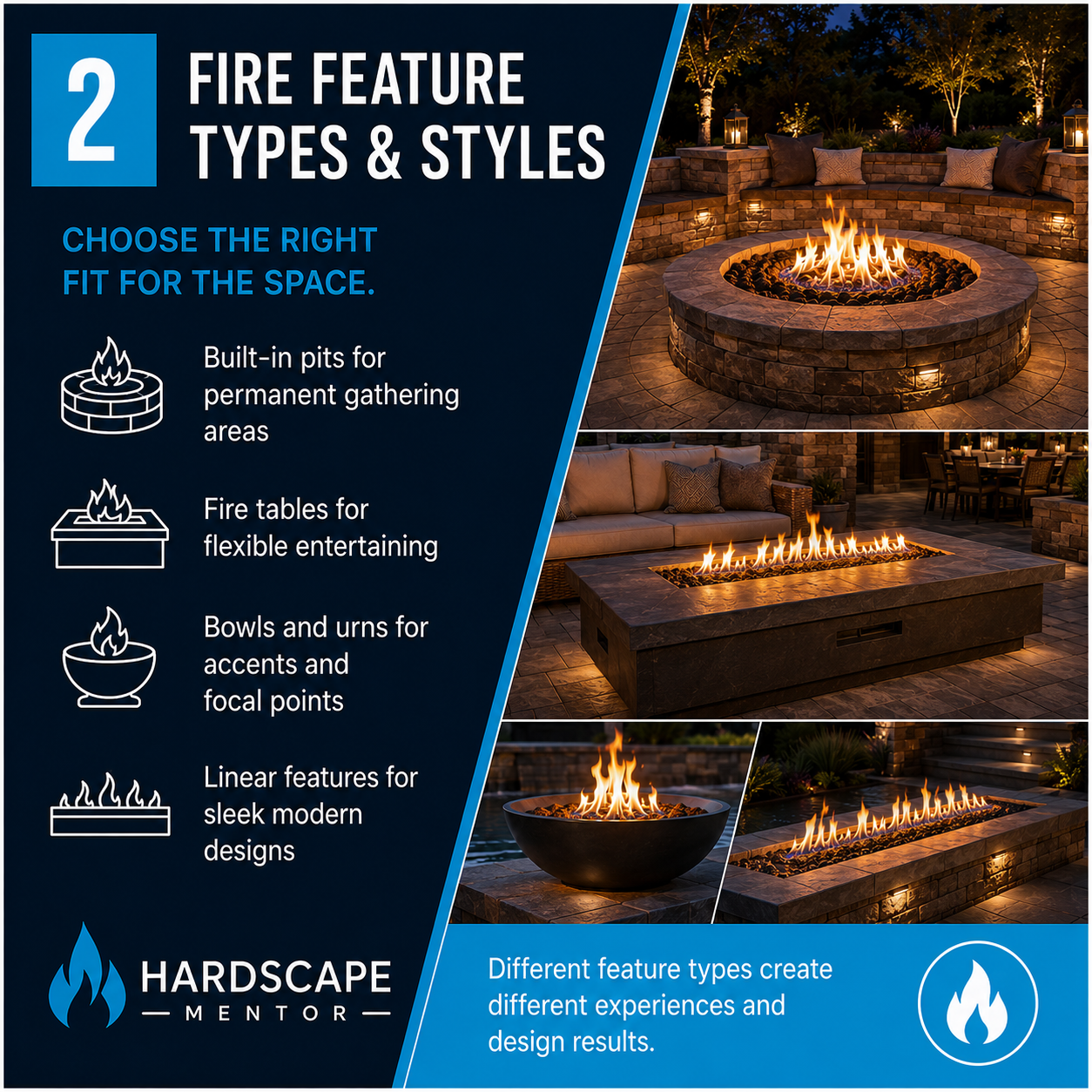
Fire pits are among the most familiar outdoor fire features and may be wood-burning, natural-gas, propane, smokeless, portable, or permanently constructed. Fire tables combine a burner with a wider surrounding surface that can complement lounge furniture and conversation areas. Fire bowls, urns, and columns create raised sculptural flames that can be used individually, in pairs, or as repeated accents throughout a landscape. Linear fire features and fire ribbons create long bands of flame that often complement modern patios, pools, walls, and outdoor kitchens.
Outdoor fireplaces create a taller architectural focal point and may include a hearth, mantel, chimney, storage areas, or adjoining seating walls. Fire walls incorporate burners into freestanding or retaining-style walls, while fire-and-water features combine flame with spillways, scuppers, bowls, fountains, or pool elements. Torches and flame lanterns can define walkways, entrances, pool decks, and entertainment areas. Built-in radiant heaters and approved freestanding patio heaters may also supplement warmth in larger outdoor rooms. A Hardscape Mentor Certified Contractor should help homeowners compare the appearance, heat output, installation requirements, maintenance, and intended use of each option.

Find a Certified Contractor Today
Ready to start your next outdoor living project? Use our contractor locator to connect with verified Hardscape Mentor Certified Contractors in your area.

Wood-burning features provide the sound, aroma, flame movement, sparks, and traditional appearance many homeowners associate with an outdoor fire. They require firewood storage, ash removal, more active supervision, and greater consideration of smoke, wind, and nearby combustible materials. Wood-burning fireplaces and pits may also be affected by burn bans, drought restrictions, or local air-quality rules. The fire chamber, chimney, spark control, and surrounding materials should be designed specifically for wood combustion.
Natural gas and propane features offer faster ignition, cleaner operation, and easier flame adjustment. Natural gas normally requires a permanent utility connection, while propane may be supplied by a concealed portable cylinder or a larger remote tank. Approved ethanol or bioethanol features may be available for certain decorative applications, while some outdoor products use electric flame effects or electric radiant heat instead of open combustion. Every fuel has different burner, ventilation, regulator, storage, and service requirements. A Hardscape Mentor Certified Contractor should coordinate the selected fuel with the feature design and involve qualified gas or electrical professionals when licensed utility work is required.
A fire feature should not be placed solely where there is open patio space. The home, roof overhangs, fences, trees, pergolas, outdoor furniture, utilities, neighboring properties, landscaping, and property boundaries can all influence the final location. The area should provide enough room for guests to approach, sit, stand, and move around the feature without crowding the flame. The location should also allow service access to burners, valves, tanks, controls, and drainage components.
Prevailing wind can affect flame stability, smoke movement, spark travel, and guest comfort. Wood-burning features positioned in a wind corridor may repeatedly direct smoke toward seating or neighboring properties. Gas flames may become distorted or difficult to maintain when exposed to strong wind unless the system is designed for those conditions. Covered patios and enclosed outdoor rooms require additional evaluation because many fire-feature systems are not approved for those locations. A Hardscape Mentor Certified Contractor should follow manufacturer instructions and applicable local requirements when establishing clearances and selecting the site.


Outdoor fire features may be constructed with engineered concrete block, natural stone, brick, poured concrete, steel, stainless steel, copper, corten-style weathering steel, cast concrete, or approved manufactured systems. Masonry cores may be finished with stone veneer, brick veneer, porcelain, tile, stucco, or other exterior materials suitable for the installation. The visible exterior creates the architectural style, but the internal combustion area must also be designed for the fuel, burner, temperature, and airflow requirements.
Materials placed near direct flame should not be selected only for appearance. Firebrick, metal liners, burner pans, insulated components, expansion joints, and approved heat-resistant materials may be required within or around the fire chamber. Porous natural stone should be evaluated carefully because moisture trapped within certain stones may react poorly to intense heat. Caps and coping should resist weather exposure, staining, movement, and repeated temperature changes. A Hardscape Mentor Certified Contractor should coordinate the foundation, enclosure, internal components, finish materials, ventilation, and drainage as one complete system.
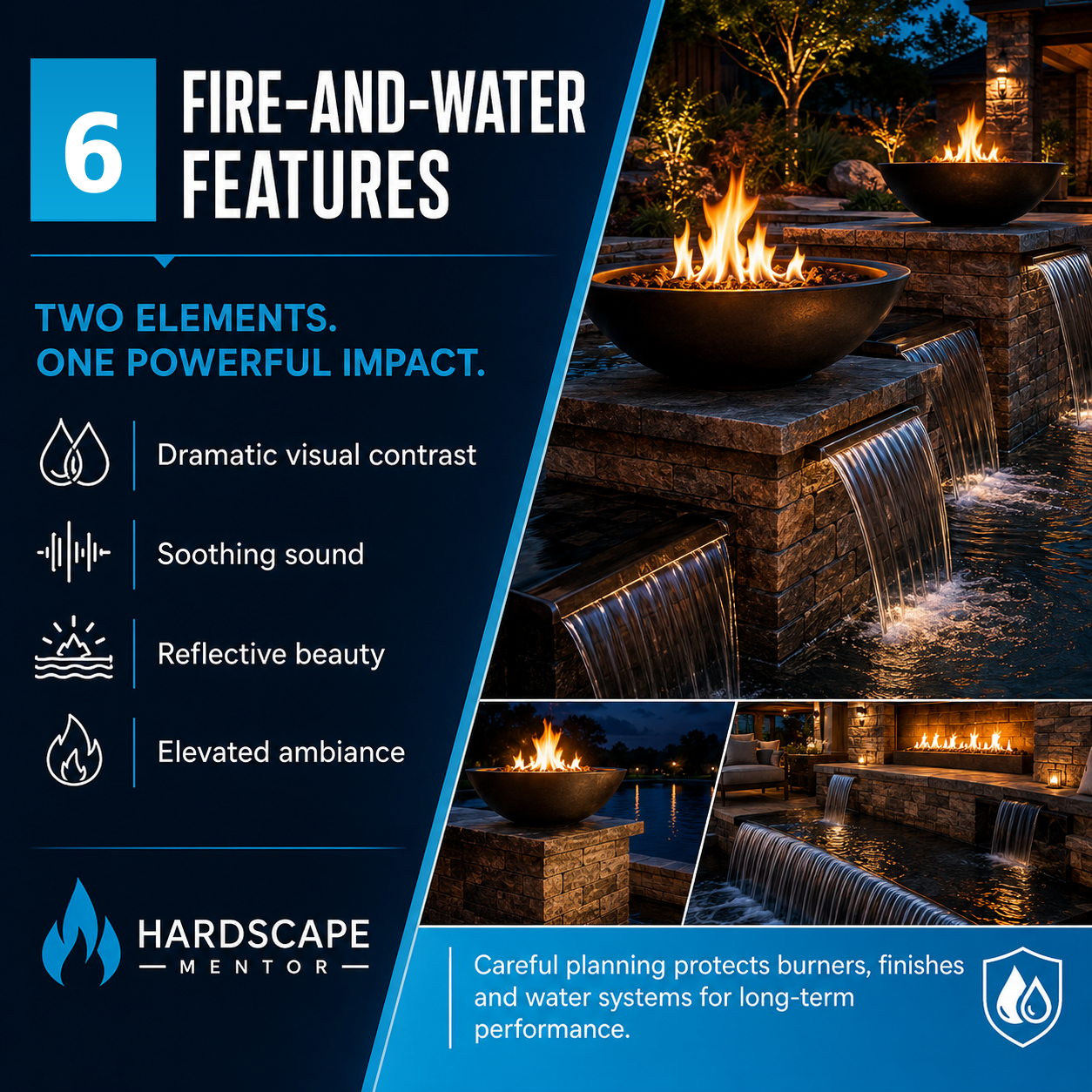
Fire-and-water features combine contrasting elements to create movement, sound, reflection, and visual interest. Common designs include fire bowls with water spillways, flaming pool scuppers, fire tables beside fountains, fire walls behind reflecting pools, and raised bowls that send water into a pool while supporting a flame above. These features can become prominent focal points when viewed from patios, pools, windows, or outdoor dining areas.
Combining fire and water requires careful technical planning. Splash, wind, evaporation, corrosion, burner drainage, electrical components, water chemistry, and fuel lines must be considered together. The flame and burner should remain protected from excessive water while the water system must be serviceable without disturbing the fire components. Pool chemicals and constant moisture may affect metal finishes, ignition systems, fasteners, and surrounding masonry. A Hardscape Mentor Certified Contractor should coordinate with qualified pool, gas, plumbing, and electrical professionals when a project combines multiple systems.

Fire tables provide both a visible flame and a surrounding ledge or tabletop-style surface. They may be coffee-table height, dining height, bar height, or custom-built to match lounge seating. Fire bowls and fire urns create a more sculptural appearance and are often placed on columns, walls, pool decks, entry features, or landscape terraces. Fire columns create compact vertical accents that can frame entrances, outdoor rooms, pools, and seating areas.
Torches may be permanently connected to a fuel system or designed as portable units. They can define walkways, highlight architectural features, create rhythm along a pool deck, or mark the entrance to an outdoor entertainment area. Flame lanterns and smaller fire accents may provide atmosphere without generating the same gathering pattern as a central fire pit. The scale and placement of these features should be carefully controlled so the landscape does not feel crowded or overly theatrical. A Hardscape Mentor Certified Contractor should coordinate their height, fuel supply, service access, visibility, wind exposure, and relationship to nearby plants and structures.
Outdoor fireplaces create height, enclosure, and a strong focal point within an outdoor living area. They may be wood-burning or gas-fueled and can include hearths, mantels, chimneys, log storage, television niches, seating walls, and adjoining kitchen or dining areas. Their size and vertical form can help define an outdoor room, screen an unwanted view, or create a visual connection with the architecture of the home.
Fire walls and linear features create a different appearance. A low wall with a long burner can divide spaces while preserving open views, while a taller fire wall may incorporate stone, tile, metal panels, water, lighting, or multiple burner openings. These features require careful consideration of heat movement, wall construction, ventilation, access panels, and surrounding finishes. Televisions, artwork, pergolas, and decorative elements should not be placed near heat without proper evaluation. A Hardscape Mentor Certified Contractor should coordinate the feature’s structure, burner system, chimney or venting needs, and connection to the rest of the hardscape.


Gas fire features may include circular burner rings, linear burners, H-shaped burners, crossfire-style systems, custom burner arrays, and preassembled burner pans. The system may also include regulators, air mixers, shutoff valves, ignition assemblies, flame sensors, control modules, ventilation openings, and decorative fire media. Each component must be compatible with the selected fuel and enclosure.
Ignition options include manual match-light systems, push-button spark ignition, electronic ignition, remote controls, timers, and automated safety systems. Some larger installations may be connected to home-automation or pool-control systems when approved components are used. Access panels should be incorporated so valves, batteries, electronics, and connections can be inspected without dismantling the surrounding hardscape. Drainage should protect the burner pan and ignition components from standing water. A Hardscape Mentor Certified Contractor should coordinate the complete system with qualified utility professionals and follow the burner manufacturer’s specifications.
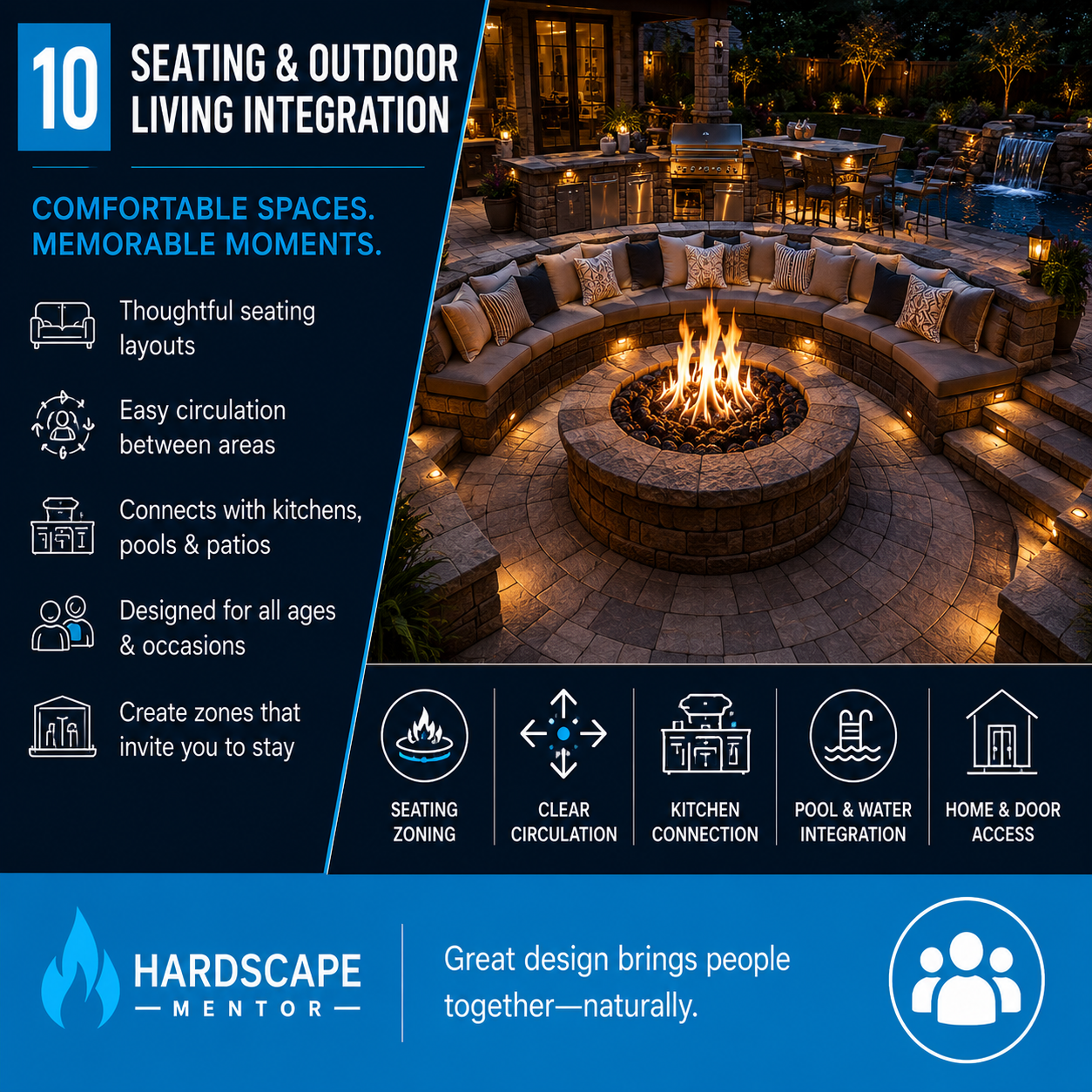
A central fire feature often becomes the social focus of a patio. Seating may include movable chairs, sectional furniture, built-in seating walls, benches, seat-height planters, or combinations of permanent and flexible options. The arrangement should account for heat output, feature shape, group size, and how people enter and leave the area. Round pits often work well with circular seating, while linear fire tables may complement straight sofas, dining layouts, and contemporary spaces.
Fire features should also be coordinated with outdoor kitchens, dining tables, pools, spas, doors, walkways, and entertainment areas. Guests should not be forced to pass too close to the flame when moving between spaces. Built-in walls should include practical openings and should not trap people within the gathering area. The layout should consider children, older adults, pets, serving routes, and furniture adjustments. A Hardscape Mentor Certified Contractor should plan the fire feature and surrounding patio as one complete outdoor living environment.

Outdoor fire features are exposed to rain, snow, freezing temperatures, sunlight, irrigation, leaves, pollen, insects, and changing humidity. Water can collect in burner pans, fire chambers, gas valves, media, and drainage openings if the feature is not properly protected. Freeze-thaw cycles can affect masonry, caps, mortar, veneers, and porous materials. Coastal environments, pool chemicals, and constant moisture can also accelerate corrosion of metal components.
Maintenance requirements vary by feature type. Wood-burning systems require ash removal and inspection of the fire chamber, spark-control components, and chimney. Gas features may require burner-port cleaning, media adjustment, ignition service, drainage checks, and inspection of valves and connections. Weather covers, burner lids, vents, joints, caps, and nearby landscaping should be checked regularly. Lighting around the feature should also be maintained so steps, seating edges, and circulation routes remain visible. A Hardscape Mentor Certified Contractor should explain expected seasonal care before the homeowner selects the system.
Outdoor fire features combine hardscape design with heat, fuel, utilities, drainage, ventilation, structural support, and safety considerations. Homeowners should ask contractors which types of fire features they have built and whether they have experience with the proposed fuel, burner, materials, and surrounding outdoor living design. A contractor should be able to explain how the foundation, enclosure, ventilation, drainage, utility access, and service panels will be constructed. Photographs and references from similar completed projects can help homeowners evaluate relevant experience.
The proposal should identify the feature type, dimensions, materials, fuel source, burner system, ignition method, fire media, accessories, and surrounding hardscape work. It should also address permits, inspections, licensed utility work, warranties, operating instructions, and maintenance responsibilities. A Hardscape Mentor Certified Contractor should communicate these details clearly before construction begins and coordinate with qualified gas, plumbing, electrical, pool, or engineering professionals when required. Choosing the right contractor helps reduce installation problems, unexpected costs, difficult future repairs, and performance issues.


Image #1
Lorem ipsum dolor sit amet, consectetur adipiscing elit.

Image #2
Lorem ipsum dolor sit amet, consectetur adipiscing elit.

Image #3
Lorem ipsum dolor sit amet, consectetur adipiscing elit.

Image #4
Lorem ipsum dolor sit amet, consectetur adipiscing elit.
Image #5
Lorem ipsum dolor sit amet, consectetur adipiscing elit.

Image #6
Lorem ipsum dolor sit amet, consectetur adipiscing elit.
Find a Hardscape Mentor Certified Contractor Today
A successful hardscape project begins with thoughtful planning and continues with construction methods suited to the property, climate and intended use.