
 A professionally designed flagstone patio can create a natural, high-end outdoor living space that feels connected to the home and surrounding landscape. Flagstone may be installed in irregular organic layouts, more structured dimensional patterns, or mixed-material designs that incorporate concrete pavers, brick borders, masonry walls, steps, fire features, and landscape lighting.
The quality of a flagstone patio depends on much more than selecting attractive stone. Proper excavation, drainage, base preparation, stone thickness, bedding, joint design, edge support, cutting, and finishing details all affect how the patio performs. Hardscape Mentor’s contractor-training library includes flagstone, base preparation, open-graded construction, cutting, borders, jointing materials, design, and complete patio-building techniques.
A Hardscape Mentor Certified Contractor should help homeowners understand how these elements work together to create a flagstone patio that is attractive, functional, and suitable for the property.
The first step in designing a flagstone patio is understanding how the space will be used. A small sitting area requires a different layout from a patio designed for outdoor dining, grilling, entertaining, lounge furniture, a fire feature, or an outdoor kitchen. The number of people using the patio, the size of the furniture, and the connections to the home and yard should all influence the final dimensions.


The design should include enough room for chairs to be pulled away from tables, people to move around furniture, and doors or gates to open without obstruction. Cooking areas, fire features, steps, retaining walls, and walkways should be positioned so they do not interfere with normal circulation.
A Hardscape Mentor Certified Contractor should help organize the patio into comfortable activity zones while maintaining a natural visual flow. Hardscape Mentor design training emphasizes purposeful layouts, contrasting materials, natural-stone integration, custom borders, and designs that are practical to build.
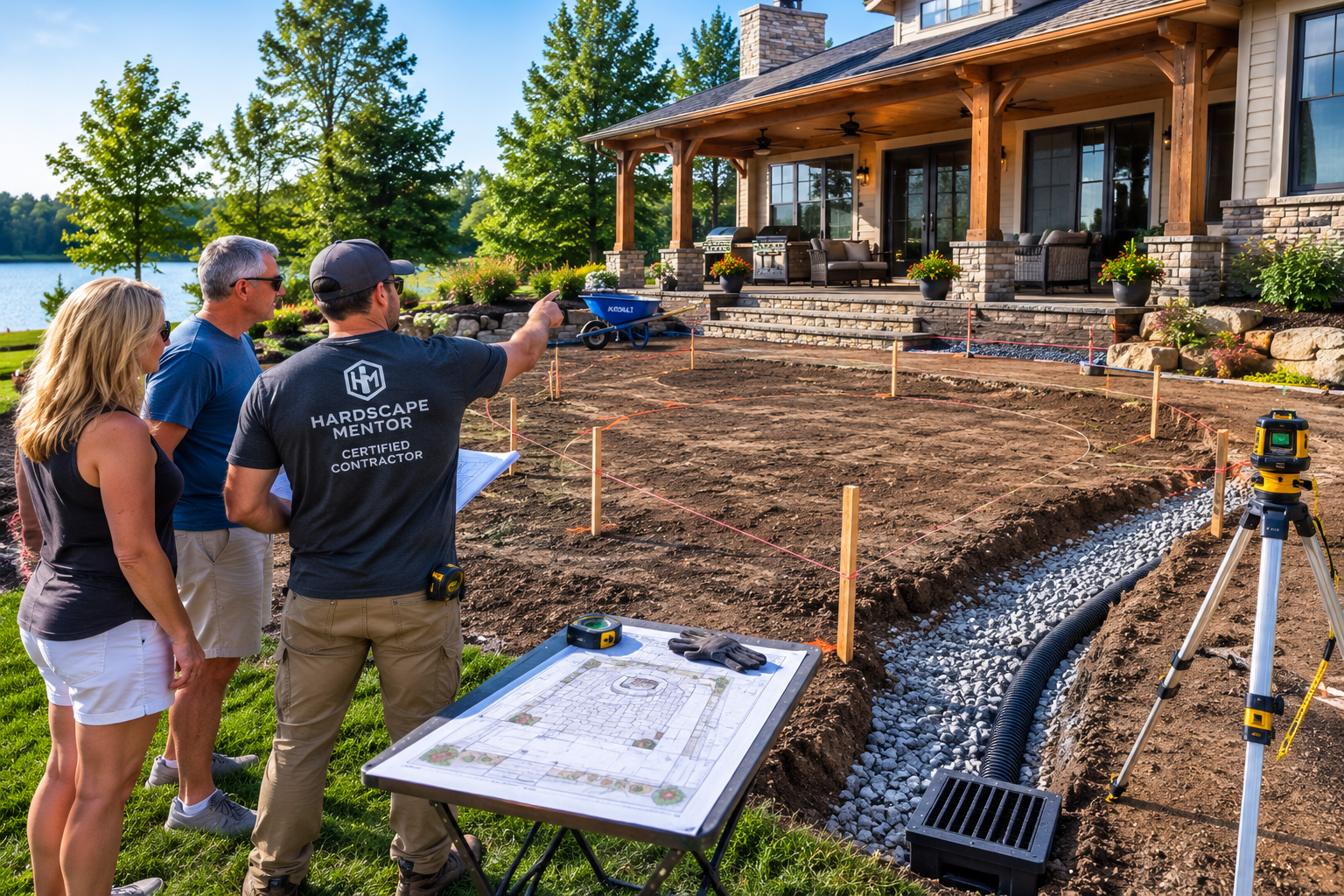
Before flagstone is selected, the contractor should evaluate the soil, slope, drainage, access, utilities, downspouts, tree roots, door thresholds, foundations, and existing hardscape. The patio must fit the property’s elevations while directing surface water away from the house and other structures.
Poor drainage can contribute to standing water, erosion, settlement, stained stone, unstable joints, and freeze-thaw movement. Depending on the property, drainage may be managed through surface slope, open-graded aggregate, permeable joints, channel drains, catch basins, underground piping, or landscaped discharge areas.
An Open Graded Base can allow water to move through interconnected voids in clean angular stone, but the water still needs a suitable outlet or infiltration strategy. Hardscape Mentor’s base-preparation training specifically addresses open-graded construction, aggregate selection, bedding chips, excavation, and drainage-related installation practices.

Find a Certified Contractor Today
Ready to start your next outdoor living project? Use our contractor locator to connect with verified Hardscape Mentor Certified Contractors in your area.

“Flagstone” is a broad term for flat natural stone used in patios, walkways, steps, and other exterior surfaces. Available stone varies by region and may include sandstone, limestone, slate, quartzite, bluestone, or other natural materials. Each type has different colors, textures, density, thickness, absorption characteristics, and weathering patterns.
Irregular flagstone creates an organic appearance with natural shapes and varied joints. Dimensional flagstone is cut into squares or rectangles for a more structured design. Both can produce a high-end patio, but they require different layouts, cutting methods, jointing details, and labor.
Stone thickness should be compatible with the installation system. Thick, durable stone may be suitable for a flexible base, while thinner material may require a rigid or bonded installation designed specifically for natural stone. Hardscape Mentor training includes flagstone installation, base preparation, layouts, cutting, and techniques intended to improve consistency and craftsmanship.
The stone surface is only the visible portion of a larger patio system. Excavation, subgrade preparation, aggregate depth, compaction, drainage, bedding, and edge containment determine whether the patio remains stable.
Organic soil, loose fill, construction debris, and soft areas should be removed or corrected before the base is installed. The required excavation and base depth depend on soil strength, drainage, climate, stone thickness, patio use, and the selected installation method.
Where appropriate, a Hardscape Mentor Certified Contractor may recommend an Open Graded Base made from clean, angular aggregate with limited fines. The aggregate interlocks structurally while allowing water to move through the base. Hardscape Mentor’s base-preparation training specifically addresses why open-graded systems are used and how contractors select the stone and bedding chips.
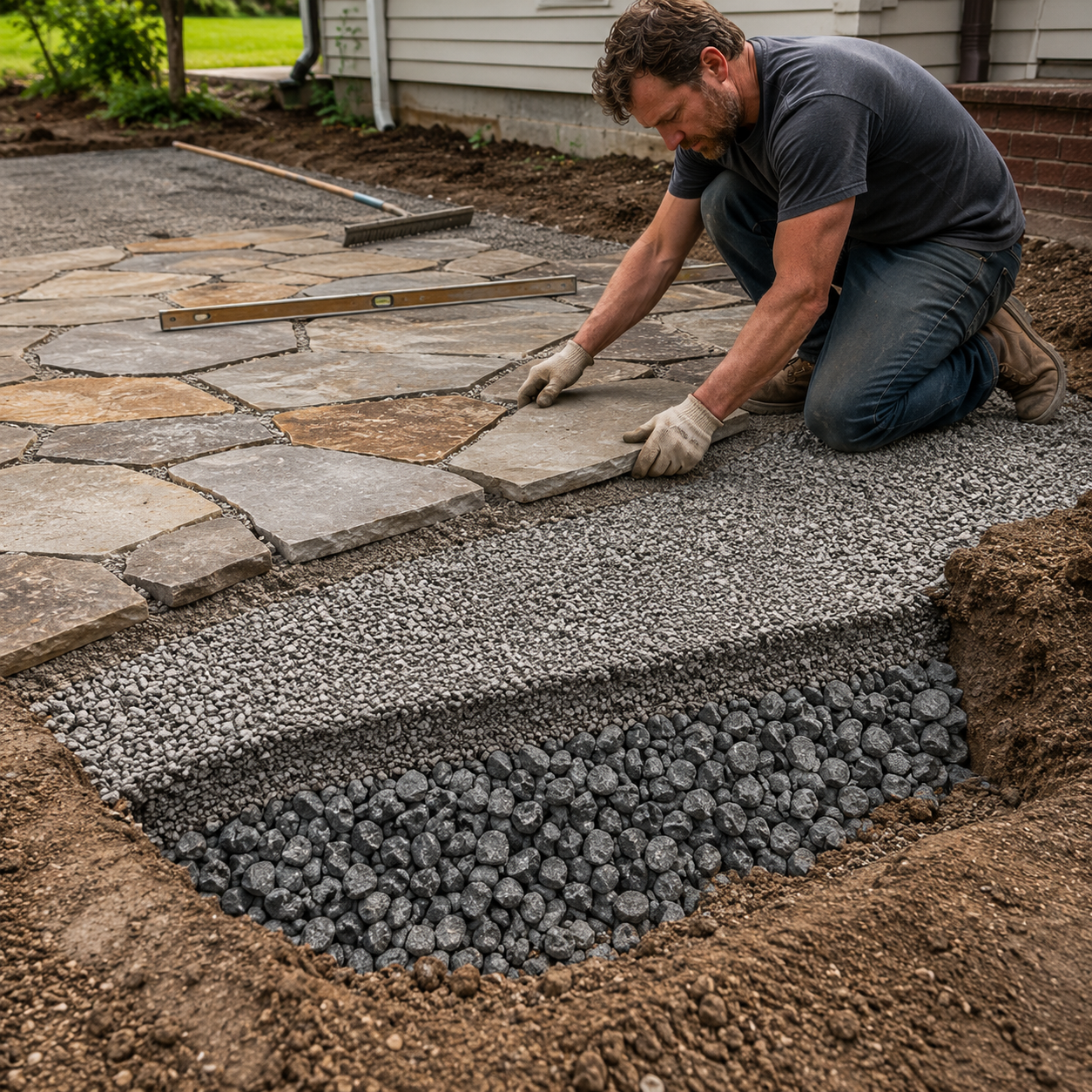
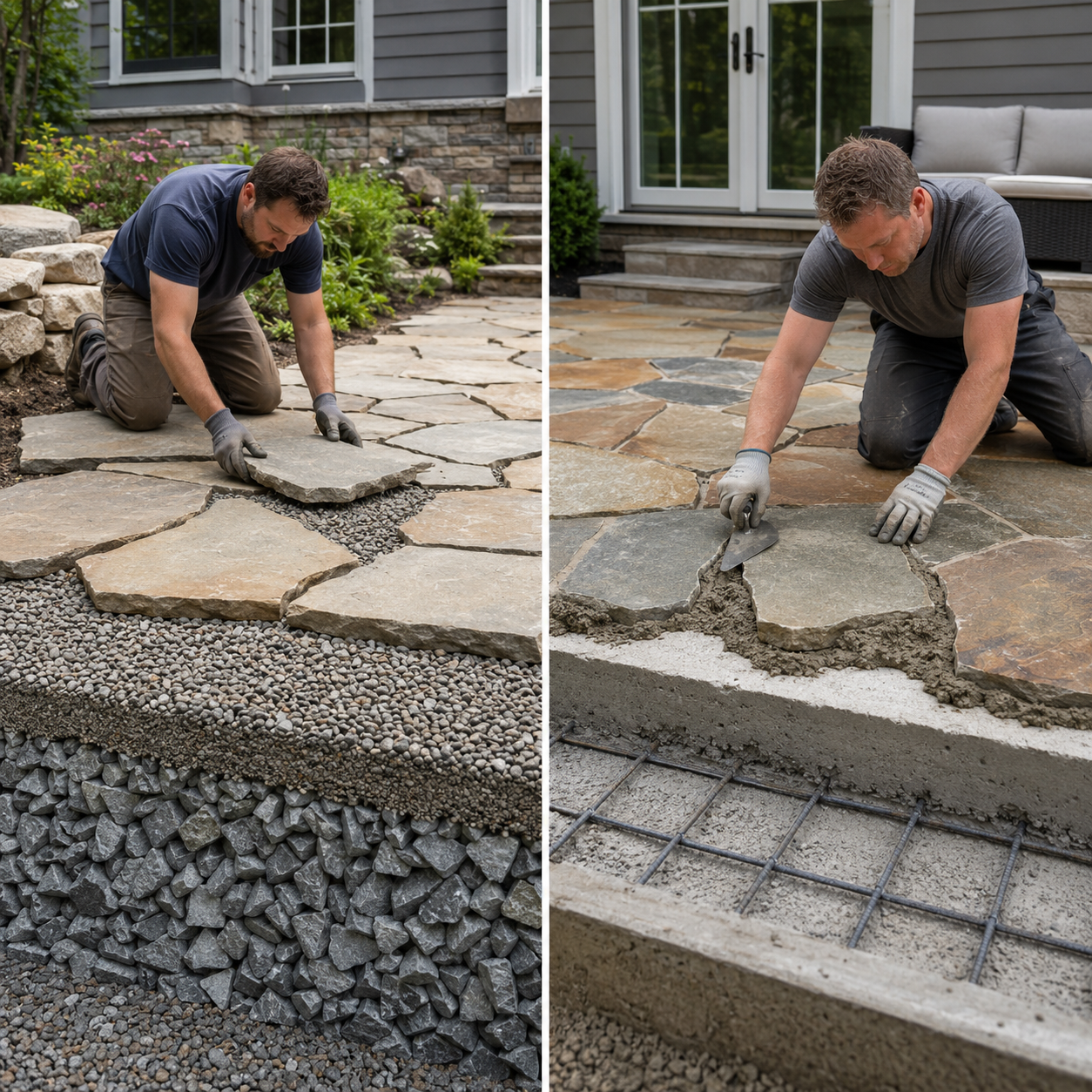
Flagstone patios may be installed using a flexible, dry-laid system or a rigid, bonded system. In a dry-laid installation, the stone is supported by aggregate base and a compatible setting layer. The joints may be filled with stabilized sand, resin material, permeable chips, or another product designed for the assembly.
A rigid installation may use a reinforced concrete slab, mortar bed, drainage layer, or specialized permeable rigid system. Thin natural stone and large-format materials often require more controlled support and bonding than thick flagstone.
Homeowners should not assume that one method is always superior. The correct system depends on stone thickness, climate, drainage, soil, structure, joint design, and manufacturer requirements. Hardscape Mentor also provides training on trass bedding and permeable rigid base systems intended to support natural stone and other thin exterior materials.
The setting layer allows individual flagstones to be adjusted to the required elevation while receiving consistent support. It should be compatible with the base and stone installation method. Bedding should not be used to hide major base irregularities or compensate for poor excavation.
Each stone should be placed so it does not rock, shift, or create uncomfortable elevation differences with surrounding pieces. Natural thickness variation may require careful stone selection, sorting, trimming, and individual bedding adjustments.
With an Open Graded Base system, small angular bedding chips may be used where appropriate. Rigid natural-stone systems may use trass bedding, mortar, or another approved setting product. A Hardscape Mentor Certified Contractor should explain why the selected bedding method is appropriate for the flagstone and project conditions.
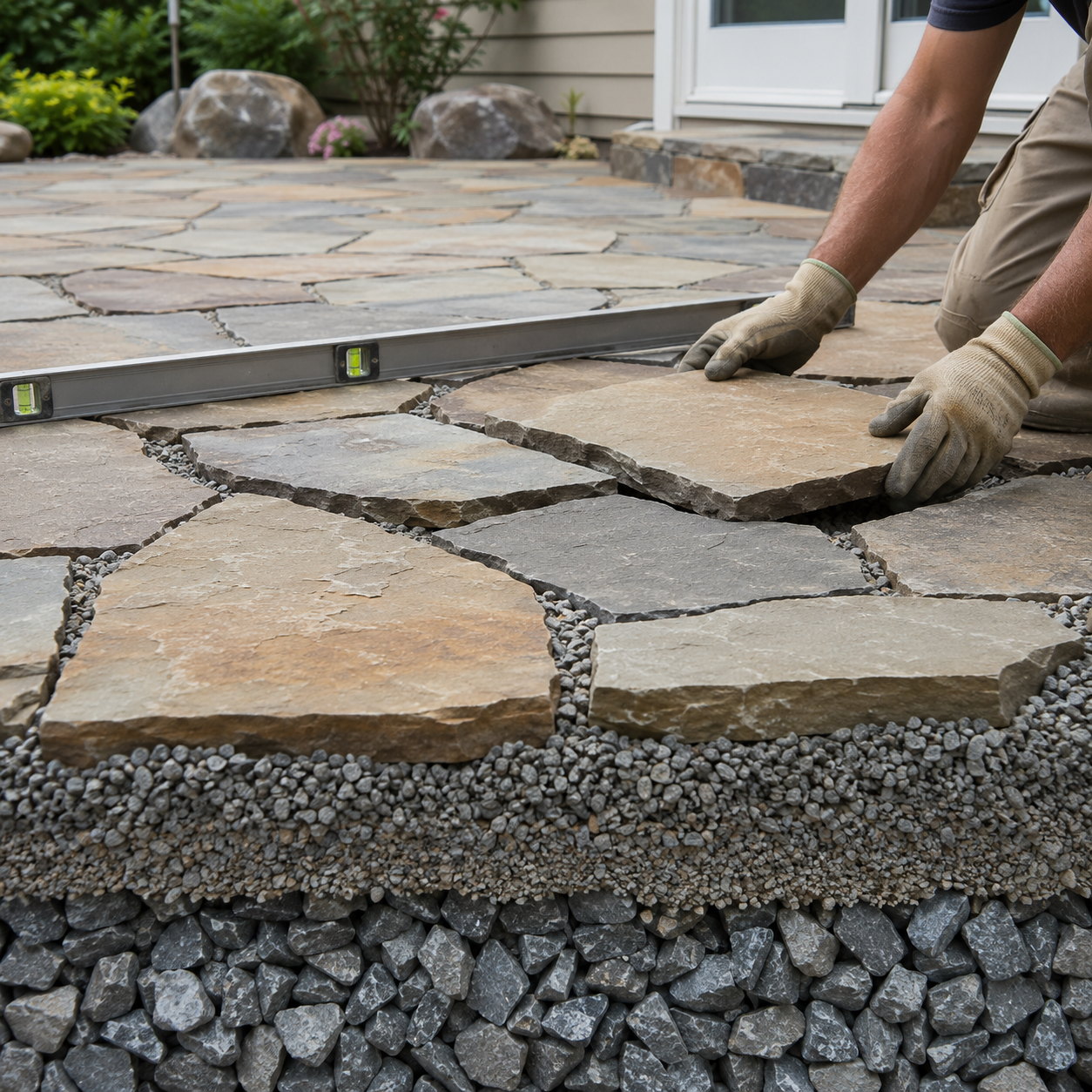

Flagstone joints are often wider and more variable than joints between manufactured pavers. The chosen joint material must be suitable for the actual width, depth, base, drainage, stone type, and expected exposure.
Available options can include conventional stone screenings, polymeric products formulated for wide joints, resin-based joint material, mortar, or stabilized permeable chips. The correct product should not be selected solely because it is familiar to the contractor.
Hardscape Mentor has published training covering wide-joint flagstone polymeric material and permeable flagstone joints using a two-finger joint design, permeable chips, and stabilizer. Product specifications vary significantly: for example, SEK Surebond’s X-Treme Wide Joint PolySweep is formulated for joints from 1/8 inch to four inches, while other natural-stone products have different width, depth, drainage, and temperature requirements.
Concrete paver borders can create a clean, consistent perimeter around an irregular flagstone field. The border may provide visual contrast, coordinate the patio with nearby walkways, define curves, or create a more formal transition between natural stone and the landscape.
Paver borders can also simplify the patio perimeter by creating a repeatable edge for cutting and joint alignment. However, the border and flagstone must be supported by a compatible base and bedding system. The structural base should extend beyond the finished surface so the perimeter is not resting beside unsupported soil.
Hardscape Mentor design training specifically includes flagstone inlays, banding, borders, contrasting textures, and natural-stone integration. CMHA guidance also emphasizes that paver edge restraints must contain the bedding and lower portion of the border units to preserve pavement stability.

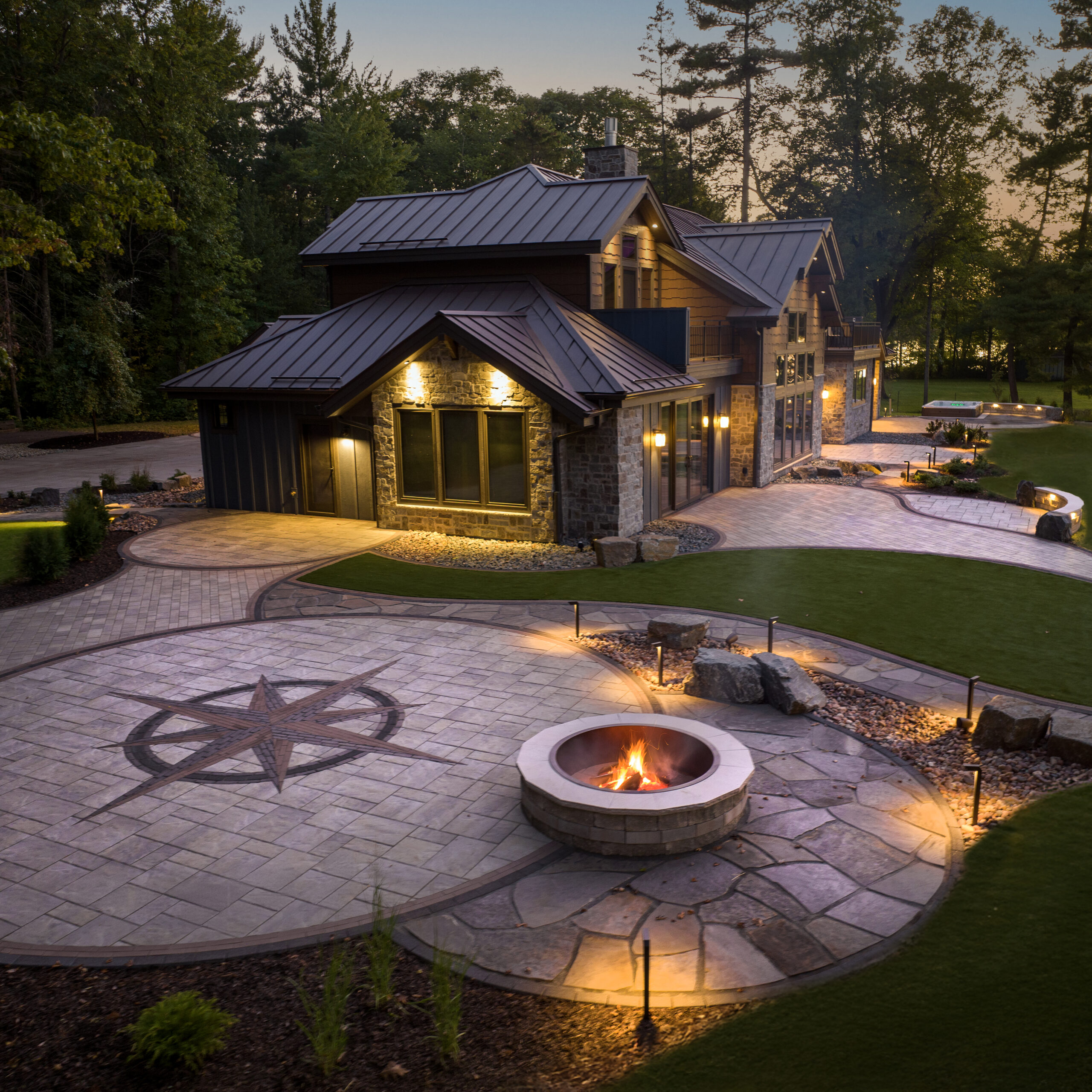
Flagstone can be incorporated into a mixed-material patio rather than covering the entire surface. It may be used as an inlay within concrete pavers, a central gathering area, a decorative transition, a walkway connection, or an accent around a fire feature.
Concrete pavers can provide structured borders and high-traffic zones, while natural flagstone adds variation in color, shape, and texture. Brick, porcelain, concrete, decorative aggregates, wall stone, and natural boulders may also be integrated when the overall palette remains coordinated.
Successful material mixing requires more than placing different products beside one another. Thicknesses, joint widths, bedding, movement, drainage, cutting, and edge support must be coordinated. Hardscape Mentor’s advanced design training covers inlays, borders, banding, flagstone layouts, and the strategic use of contrasting materials and textures.
Flagstone patios frequently connect to natural-stone steps, retaining walls, seating walls, boulders, fire pits, fireplaces, and outdoor kitchens. These features should be planned together so their foundations, elevations, materials, and drainage systems work as one outdoor environment.
Large cap stones, paver borders, wall blocks, and matching veneer can help coordinate vertical features with the patio surface. Flagstone may be repeated on stair treads, wall caps, hearths, or accent areas, provided the selected stone and installation method are suitable.
Gas, electrical, drainage, and lighting lines should be coordinated before the patio surface is installed. Hardscape Mentor’s training library covers patios, fire pits, steps, walls, flagstone, lighting, borders, and design integration.


Natural stone responds differently to moisture, freezing temperatures, direct sunlight, deicing products, leaf stains, cooking grease, and seasonal movement. The selected flagstone should be appropriate for the regional climate and intended use.
Routine maintenance may include sweeping, washing, treating stains, removing organic growth, clearing drains, replenishing joints, and inspecting loose stones or damaged edges. Some flagstone patios may benefit from an appropriate sealer, while others may be left untreated to preserve their natural appearance.
Joint products also have specific maintenance and installation limitations. Manufacturers specify allowable joint widths, depths, base types, activation procedures, temperatures, and curing conditions. A Hardscape Mentor Certified Contractor should provide product-specific care instructions instead of describing the patio as maintenance-free.
Flagstone construction requires judgment that cannot be reduced to a single installation formula. The contractor must evaluate the stone, soil, drainage, climate, layout, base, bedding, joint material, borders, steps, walls, utilities, and surrounding landscape.
Before hiring, homeowners should ask the contractor to explain whether the patio will be dry-laid or rigid, what base and bedding materials will be used, how water will drain, how stone thickness will be managed, what joint product is proposed, and how the patio will connect to adjoining features.
A Hardscape Mentor Certified Contractor should be capable of combining flagstone craftsmanship with broader hardscape knowledge, including Open Graded Base techniques, paver borders, material inlays, edge restraints, joint selection, cutting, lighting, walls, steps, and complete outdoor-living design. Hardscape Mentor currently provides hundreds of training lessons covering projects from initial design and base preparation through installation and finishing details.

Image #1
Lorem ipsum dolor sit amet, consectetur adipiscing elit.

Image #2
Lorem ipsum dolor sit amet, consectetur adipiscing elit.

Image #3
Lorem ipsum dolor sit amet, consectetur adipiscing elit.

Image #4
Lorem ipsum dolor sit amet, consectetur adipiscing elit.
Image #5
Lorem ipsum dolor sit amet, consectetur adipiscing elit.

Image #6
Lorem ipsum dolor sit amet, consectetur adipiscing elit.
Find a Hardscape Mentor Certified Contractor Today
A successful hardscape project begins with thoughtful planning and continues with construction methods suited to the property, climate and intended use.