
 Landscape lighting can improve nighttime visibility, highlight hardscape craftsmanship, extend the use of outdoor living spaces, and create a more welcoming atmosphere around the home. A well-designed system may illuminate patios, outdoor kitchens, walkways, steps, seating walls, retaining walls, columns, driveways, water features, fire features, and important landscape elements. The best results come from planning the lighting with the hardscape instead of treating fixtures and wiring as an afterthought.
Hardscape contractors frequently install or coordinate low-voltage lighting within the structures they build. Fixtures may be recessed into steps, mounted beneath wall caps, installed inside columns, positioned along walkways, or concealed within outdoor kitchens and seating areas. The contractor must consider fixture placement, wiring routes, conduit, transformers, drainage, glare, service access, and future maintenance before construction is completed. A Hardscape Mentor Certified Contractor should coordinate these details with the property layout, homeowner’s goals, fixture manufacturer requirements, and qualified electrical professionals when required.


Landscape Lighting Should Be Planned With the Hardscape Design
Landscape lighting should be considered during the earliest stages of patio, walkway, wall, stair, and outdoor living design. Planning early allows contractors to place fixtures where they will provide useful illumination without creating exposed wires, awkward surface-mounted components, or unnecessary cuts in finished masonry. The lighting plan should identify primary walking routes, elevation changes, gathering areas, architectural features, and focal points that should remain visible after dark. It should also account for nearby doors, windows, neighboring properties, trees, and existing exterior lighting.
Homeowners should decide whether their main goals are safety, entertainment, visual ambiance, architectural emphasis, or a combination of these benefits. The contractor can then coordinate fixture locations with the hardscape layout, seating arrangements, planting beds, outdoor kitchens, fire features, and water features. Wiring routes and transformer locations should be planned before base materials, pavers, caps, and veneers are installed. A Hardscape Mentor Certified Contractor should view the lighting system as part of the complete outdoor environment rather than as a collection of unrelated fixtures.
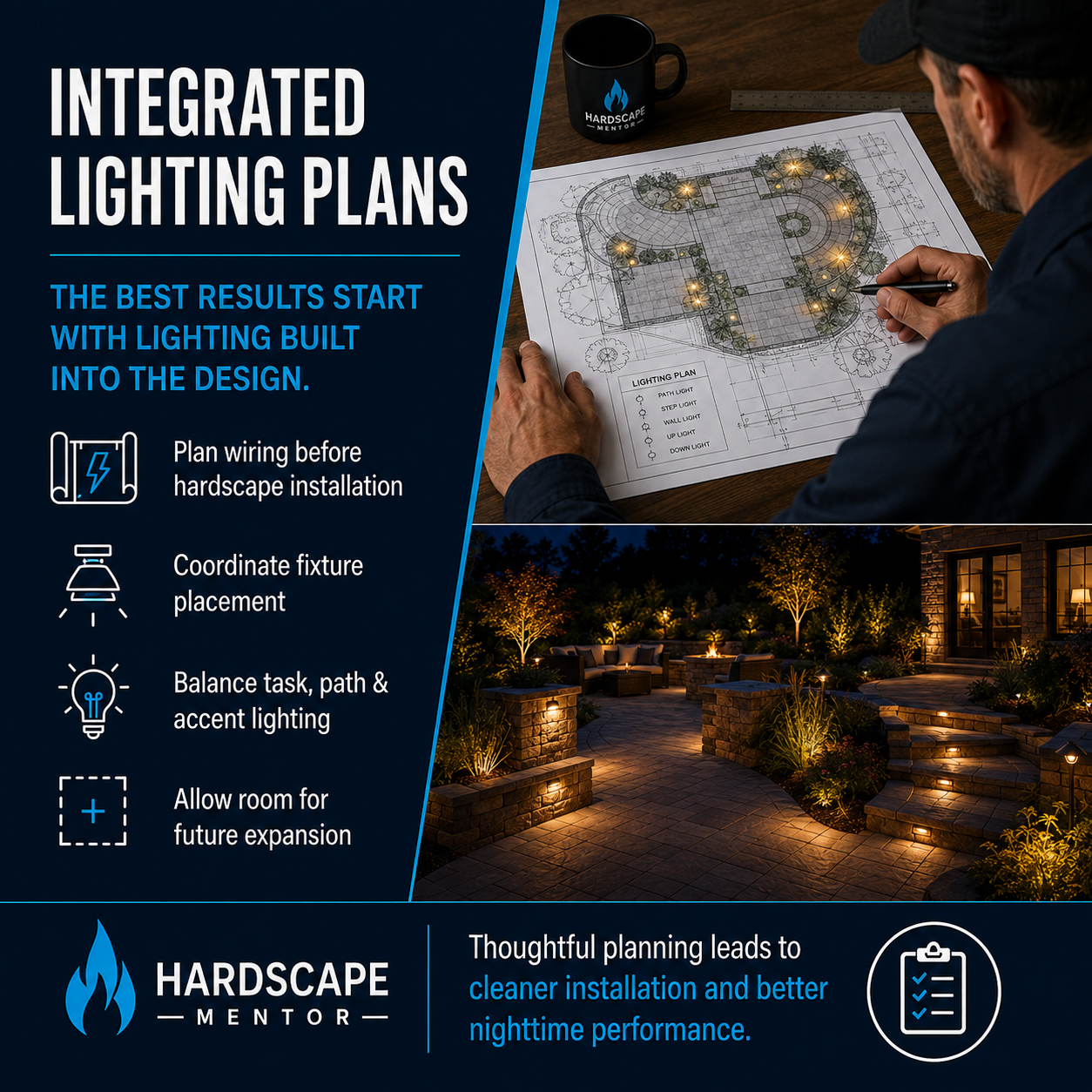
Hardscape-integrated lighting includes fixtures installed within steps, walls, columns, coping, pavers, seat walls, outdoor kitchens, and other constructed features. These fixtures can provide functional illumination while preserving a clean, finished appearance. Common options include recessed step lights, wall lights, under-cap fixtures, paver lights, niche lights, and fixtures mounted within masonry columns. The correct fixture depends on the material, available installation depth, light pattern, drainage, and accessibility for future replacement.
Fixtures should be positioned before the final courses, caps, veneers, or finished surfaces are installed. Contractors must also prevent wiring and fixture housings from interfering with structural components, drainage systems, adhesives, or wall reinforcement. Serviceable components should remain accessible without requiring major demolition. A Hardscape Mentor Certified Contractor should coordinate fixture dimensions, mounting locations, wiring paths, and manufacturer requirements with the construction sequence. Early coordination helps the lighting appear intentional and reduces visible cords, uneven spacing, and difficult repairs.

Find a Certified Contractor Today
Ready to start your next outdoor living project? Use our contractor locator to connect with verified Hardscape Mentor Certified Contractors in your area.

Steps, walkways, landings, and transitions are among the most important places to consider outdoor lighting. Changes in elevation can be difficult to see at night, especially when tread and riser materials have similar colors. Step lights may be recessed into risers, mounted in adjacent walls, positioned beneath tread overhangs, or installed in nearby columns. Walkway lighting may come from low path fixtures, downlights, paver lights, wall-mounted fixtures, or concealed sources within surrounding landscaping.
The goal is to reveal the walking surface and elevation changes without creating harsh glare directly in the user’s eyes. Fixtures should be spaced consistently enough to guide movement while avoiding an overly bright runway effect. The contractor should also consider shadows created by walls, plants, railings, and furniture. Wiring should be protected from settlement, excavation, roots, and future landscape work. A Hardscape Mentor Certified Contractor should coordinate stair dimensions, wall construction, fixture placement, and lighting direction so the completed route feels comfortable and easy to understand after dark.
Outdoor living spaces often serve several functions, including dining, cooking, conversation, relaxation, and entertainment. Each activity may require a different amount and direction of light. A dining table may benefit from soft overhead or nearby task lighting, while a lounge area may feel more comfortable with low-level wall, step, and accent lighting. Fire features already produce visible light, but they should not be expected to illuminate the entire patio safely.
Lighting should help define separate activity zones without making the outdoor space feel as bright as an interior room. Under-counter lights, wall fixtures, step lights, column lights, and carefully positioned landscape fixtures can work together to create layered illumination. Controls may allow homeowners to dim or operate different zones independently. A Hardscape Mentor Certified Contractor should coordinate lighting with furniture placement, circulation routes, doors, outdoor kitchens, fire features, and changes in elevation. Proper planning helps the patio remain functional while preserving the atmosphere that makes outdoor living appealing.
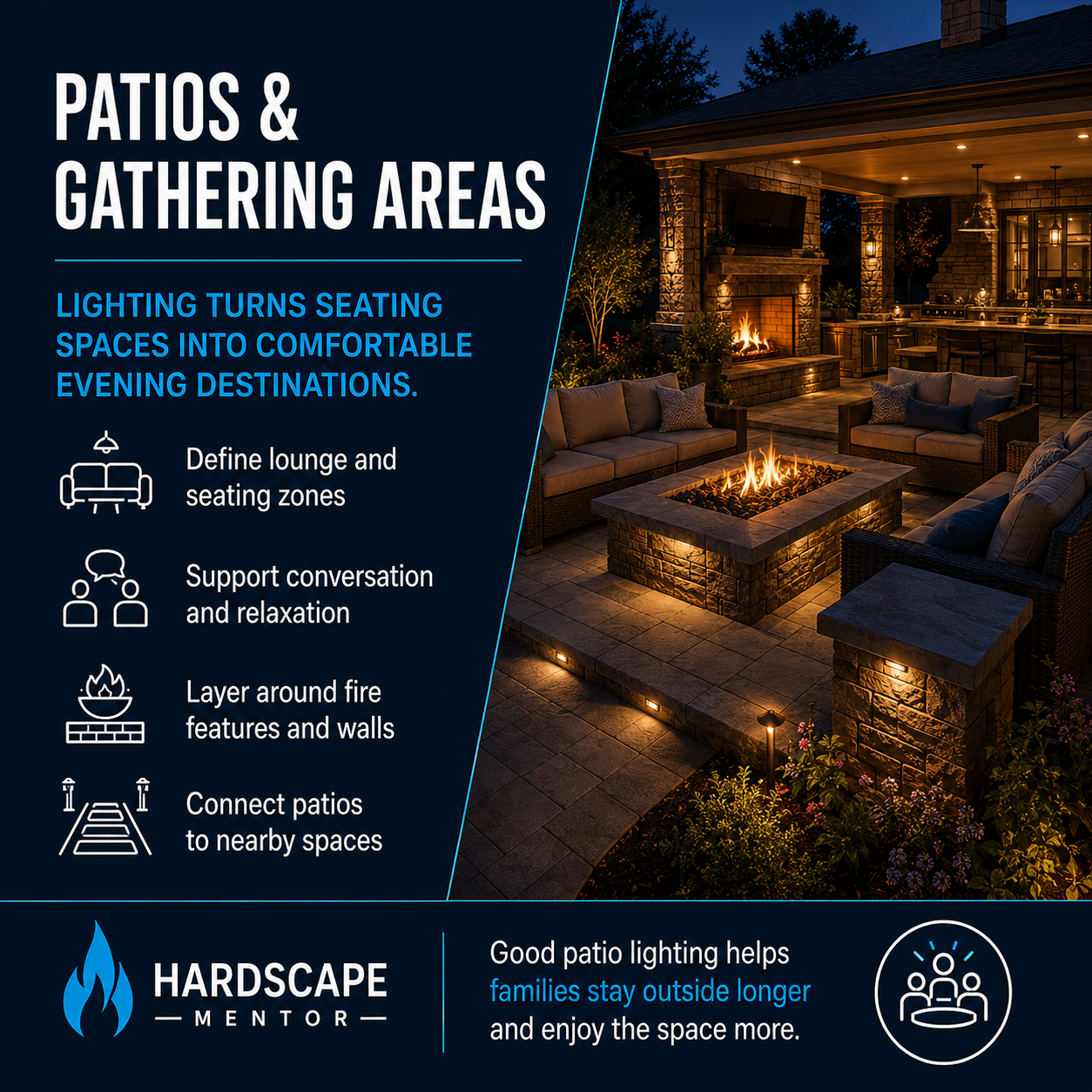

Seating walls, retaining walls, freestanding walls, raised planters, and masonry columns can provide excellent locations for concealed or recessed fixtures. Under-cap lighting can illuminate the face of a wall and the adjacent patio or walkway. Column fixtures may mark entrances, define transitions, frame steps, or create visual rhythm along the property. Recessed wall lights can improve visibility without introducing additional freestanding fixtures into narrow spaces.
The fixture should match the scale and construction of the wall or column. Wiring routes, access points, cap overhangs, veneer thickness, adhesives, and drainage must all be considered before installation. Fixtures should not weaken structural components or interfere with geogrid, reinforcement, or wall drainage. A Hardscape Mentor Certified Contractor should coordinate the lighting layout with the wall system and verify that fixtures can be serviced later. Proper integration helps the wall contribute to both the daytime design and the nighttime appearance of the property.
Outdoor kitchens require more functional lighting than many other parts of the landscape. Cooking surfaces, countertops, sinks, appliances, storage compartments, and serving areas should remain visible after dark. Lighting may be installed beneath countertops, inside cabinets, under bar overhangs, within nearby columns, or above the cooking area. Decorative lighting can also highlight stone veneer, tile, countertops, and architectural details.
Fixture placement should avoid casting strong shadows over grills and preparation surfaces. Heat, grease, smoke, weather exposure, and cleaning methods should be considered when selecting fixtures. Wiring must be coordinated with gas, water, drainage, appliance connections, and electrical components. Line-voltage work and certain appliance connections may require a licensed electrician or other qualified professional. A Hardscape Mentor Certified Contractor should coordinate the lighting with the kitchen structure from the beginning so the finished space is functional, serviceable, and visually connected to the rest of the patio.


Water features and fire features often become major nighttime focal points within an outdoor living design. Lighting can reveal waterfalls, spillways, fountains, pond edges, fire bowls, fire walls, and masonry details that may disappear into darkness. Underwater lights, niche lights, downlights, and concealed fixtures can emphasize moving water and reflective surfaces. Fire-feature lighting may focus on the surrounding structure, seating area, access route, or adjacent landscaping rather than competing directly with the flame.
Water, heat, gas, electricity, drainage, and masonry must be coordinated carefully. Fixtures near water require appropriate ratings, installation methods, and professional electrical coordination. Lighting around fire features should respect heat exposure, burner ventilation, service panels, and required clearances. A Hardscape Mentor Certified Contractor should plan these systems together with qualified pool, water-feature, gas, and electrical professionals when necessary. Proper coordination helps create a dramatic focal point without sacrificing serviceability or system performance.
Accent lighting is used to highlight trees, stone walls, columns, architectural details, sculptures, and other visual features. Uplighting directs light upward from the ground, while downlighting places fixtures above the target to create a more natural moonlight effect. Grazing positions the fixture close to a textured surface so shadows reveal stone, brick, or veneer details. Silhouetting and backlighting can emphasize the outline of a feature without illuminating it directly from the front.
Hardscape materials often respond especially well to grazing because their texture becomes more visible after dark. Fixtures should be placed carefully to avoid excessive brightness, glare, and unwanted light entering windows or neighboring properties. Plant growth should also be considered because shrubs and branches may eventually block or redirect the light. A Hardscape Mentor Certified Contractor should coordinate accent fixtures with walls, columns, paving patterns, and landscape focal points. Balanced accent lighting can make the entire outdoor space feel deeper and more visually connected.


Landscape lighting fixtures vary in size, shape, finish, light output, beam angle, shielding, and installation method. A narrow beam may highlight a column or tree, while a wider beam may illuminate a wall or planting bed. Fixture finishes should coordinate with the home, masonry, railings, appliances, and other visible materials. Dark bronze, black, stainless, and architectural finishes are common, but durability and corrosion resistance should be considered along with appearance.
Color temperature influences how stone, brick, concrete, wood, plants, and water appear at night. Warmer light often creates a comfortable residential atmosphere, while cooler light may produce a more contemporary appearance. Mixing noticeably different color temperatures within one small area can make the design feel inconsistent. Shielding and aiming are equally important because even an attractive fixture can produce uncomfortable glare when poorly positioned. A Hardscape Mentor Certified Contractor should select fixtures based on the intended effect, site conditions, construction details, and long-term serviceability.
Most residential landscape lighting systems use low-voltage power supplied through a transformer. The transformer must be sized for the connected fixtures, expected expansion, wire lengths, voltage loss, and control requirements. Larger properties may require multiple cable runs, separate zones, or more than one transformer. Transformers should be installed in accessible, ventilated locations where they can be operated and serviced without disrupting the outdoor space.
Wiring should be routed beneath or beside hardscape in a way that protects it from compaction, sharp edges, excavation, and future repairs. Conduit or sleeves may be installed beneath patios, walkways, driveways, and walls before construction is completed. Controls may include timers, photocells, switches, dimmers, remote controls, or smart-home integration. A Hardscape Mentor Certified Contractor should coordinate the wiring infrastructure with the hardscape construction and involve a qualified electrician when required. Proper system planning helps reduce voltage problems, uneven brightness, exposed wiring, and difficult future upgrades.


Landscape lighting fixtures and connections are exposed to rain, irrigation, snow, soil moisture, temperature changes, insects, mulch, fertilizers, and landscape maintenance. Products should be selected for the specific installation location, including wet, damp, buried, or submerged conditions when applicable. Drainage around recessed fixtures is important because standing water can affect housings, lenses, connections, and surrounding masonry. Freeze-thaw conditions may also influence fixture placement and mounting methods.
Routine maintenance may include cleaning lenses, adjusting fixtures, trimming plants, checking connections, replacing damaged components, and resetting timers. Paver movement, wall settlement, mulch buildup, and plant growth can change how a lighting system performs over time. Fixtures should remain accessible so they can be serviced without damaging the hardscape. A Hardscape Mentor Certified Contractor should explain maintenance expectations and provide a clear plan for accessing concealed wiring and fixtures. Durable products and thoughtful installation help the system continue performing through changing seasons and site conditions.
Landscape lighting installed with a patio, wall, stairway, or outdoor kitchen requires coordination between design, construction, electrical components, and future maintenance. Homeowners should ask contractors how fixture locations, wiring routes, sleeves, transformers, controls, and service access will be incorporated into the project. Contractors should also be able to explain how the system will avoid glare, protect wiring, handle drainage, and remain accessible after the hardscape is completed. Examples of completed nighttime projects can help homeowners evaluate the contractor’s design experience.
The proposal should identify the fixture types, approximate locations, transformer, controls, wiring method, installation responsibilities, warranties, and any work requiring another licensed professional. Homeowners should also ask how adjustments, troubleshooting, and future additions will be handled. A Hardscape Mentor Certified Contractor should coordinate lighting with the complete outdoor living design rather than installing fixtures without considering the surrounding space. Choosing the right contractor helps the lighting improve safety, highlight craftsmanship, and perform reliably for years.


Image #1
Lorem ipsum dolor sit amet, consectetur adipiscing elit.

Image #2
Lorem ipsum dolor sit amet, consectetur adipiscing elit.

Image #3
Lorem ipsum dolor sit amet, consectetur adipiscing elit.

Image #4
Lorem ipsum dolor sit amet, consectetur adipiscing elit.
Image #5
Lorem ipsum dolor sit amet, consectetur adipiscing elit.

Image #6
Lorem ipsum dolor sit amet, consectetur adipiscing elit.
Find a Hardscape Mentor Certified Contractor Today
A successful hardscape project begins with thoughtful planning and continues with construction methods suited to the property, climate and intended use.